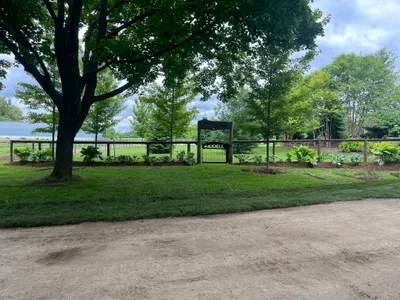
Pool fencing is one of those topics that most homeowners do not think about until they start planning a pool project. Then it comes up quickly, because the fence has to be in place before the pool can be filled.
The rules are straightforward, but they are strict. Ontario takes pool safety seriously, and the requirements exist to prevent accidental drownings, particularly involving young children. Understanding the rules early in the planning process helps avoid delays, extra costs, and potential bylaw issues down the road.
What does the Ontario Building Code require?
The Ontario Building Code (OBC) sets the baseline requirements for pool enclosures across the province. Every municipality in Ontario must enforce at least these standards, though some add additional local rules on top.
The key OBC requirements for pool enclosures:
- Every in-ground pool must be enclosed. There is no exception for rural properties, large lots, or pools that are "only used by adults."
- The enclosure must be at least 1.5 metres (approximately 5 feet) tall, measured from the outside ground level.
- The enclosure must not have openings that would allow a sphere 100 mm (about 4 inches) in diameter to pass through. This prevents small children from squeezing through gaps.
- Gates must be self-closing and self-latching. The latch must be on the pool side of the gate or at least 1.5 metres above the outside grade.
- The enclosure must completely surround the pool so that there is no unobstructed access from outside the enclosure.
The house wall can form one side of the enclosure if the doors and windows that open to the pool area are equipped with alarms or self-closing devices. But the specifics of this vary by municipality, so check with your local building department.
How tall does a pool fence need to be?
The minimum height under the OBC is 1.5 metres (about 5 feet) from the outside grade to the top of the fence. This is measured from the ground on the side away from the pool.
If the ground is not level, the height is measured from the highest point of the outside grade along each section of the fence. On sloped properties, this can mean that some sections of fence need to be taller than others to maintain the 1.5-metre minimum throughout.
A few important details about height:
- Decorative elements on top of the fence (like finials on an aluminum fence) usually do not count toward the height unless they also prevent climbing.
- Horizontal rails or features that could serve as footholds for climbing should be on the pool side of the fence, not the outside.
- Snow buildup can effectively reduce fence height in winter. This is generally not an enforcement issue since pools are closed for winter, but it is worth considering if your fence is exactly at the minimum height.
Some municipalities require more than 1.5 metres. Always check your local bylaw before purchasing materials.
What are the gate requirements?
Gates are the most important part of a pool fence because they are the weakest point in the enclosure. The OBC has specific requirements:
- Self-closing. The gate must close automatically from any open position. This is typically achieved with spring hinges or a hydraulic closer.
- Self-latching. The latch must engage automatically when the gate closes. No manual action should be needed to secure the gate.
- Latch placement. The latch must be on the pool side of the gate, or if it is on the outside, it must be at least 1.5 metres above the outside grade. This prevents young children from reaching the latch.
- Gate swing direction. The gate should swing away from the pool (outward) so that it cannot be pushed open from the outside by leaning on it.
- No locks that prevent self-closing. You can add a keyed lock for additional security, but the gate must still be able to self-close and self-latch even without the lock being engaged.
The most common compliance issue we see is gates that do not close properly. Over time, spring hinges wear out, the gate sags, or something blocks the latch from engaging. Regular maintenance of the gate hardware is important.
What are the City of London's specific pool fence rules?
The City of London enforces the Ontario Building Code requirements and adds its own municipal bylaws on top. If you are building a pool in London, here is what to know:
- A swimming pool enclosure permit is required before any pool construction begins. Not after the pool is in. Before.
- The permit application requires a site plan showing the pool location, fence location, gate locations, and setback distances from property lines.
- An inspection is required after the fence is installed to confirm it meets the code. The pool cannot be filled until the fence passes inspection.
- The fence must enclose the entire pool area, including the patio, equipment pad, and any area within the enclosure.
London's building department is generally responsive and can tell you exactly what they need when you apply. Your pool installer should handle the permit application as part of the project, but make sure you confirm that it is included in their scope of work.
The surrounding municipalities we serve, including Middlesex Centre (Komoka), Strathroy-Caradoc (Strathroy), Thames Centre (Dorchester), and the City of St. Thomas, each have their own permit processes and may have slightly different requirements. Your installer should know the rules for your specific municipality.
Can your existing fence count as a pool fence?
Maybe. Many homeowners already have a fence around their backyard and wonder whether it will meet the pool fence requirements. Here is what to check:
| Requirement | Does Your Existing Fence Meet It? |
|---|---|
| Height (min. 1.5 m / 5 ft) | Many yard fences are 4 feet tall, which is not enough |
| No gaps wider than 100 mm | Picket fences and chain link usually comply; split rail does not |
| Self-closing, self-latching gates | Most yard gates are not self-closing |
| Latch on pool side or at 1.5 m height | Most yard gates have latches on the outside at a reachable height |
| No climbable features on outside | Horizontal rails on the outside make a fence climbable |
The most common issue is height. Standard residential yard fences in Ontario are often 4 feet (1.2 metres) tall. That is not enough. You either need to add a topper to bring it up to 5 feet, or replace the fence.
The second most common issue is the gate hardware. Standard gate latches and hinges almost never meet the self-closing, self-latching requirement. Upgrading the hardware is usually straightforward and much cheaper than replacing the entire fence.
What materials can you use for a pool fence?
The OBC does not dictate which material you must use for a pool fence. It only specifies the performance requirements (height, gap size, gate function). You can use whatever material meets those requirements.
Here are the most common pool fence materials in Ontario:
| Material | Pros | Cons | Cost Range (per linear foot) |
|---|---|---|---|
| Chain link (vinyl coated) | Affordable, durable, low maintenance | Not the most attractive option | $20 – $35 |
| Wood (pressure treated) | Natural look, privacy, affordable | Requires staining/sealing, can warp | $30 – $50 |
| Wood (cedar) | Beautiful, naturally rot-resistant | Higher cost, still needs maintenance | $40 – $65 |
| Ornamental aluminum | Clean look, maintenance-free, durable | No privacy, higher cost | $45 – $70 |
| Vinyl / PVC | Low maintenance, clean appearance | Can become brittle in extreme cold | $35 – $55 |
| Glass panel | Unobstructed views, modern look | Expensive, requires regular cleaning | $80 – $150+ |
The most popular choices in Southwestern Ontario are wood privacy fencing and ornamental aluminum. Wood gives you privacy and a natural look. Aluminum gives you visibility (you can see the pool from the house) and zero maintenance.
If you choose wood, make sure the design does not create footholds on the outside that would allow a child to climb the fence. A solid privacy board fence meets this requirement naturally. A fence with horizontal rails on the outside does not.
How much does a pool fence cost in Ontario?
The total cost depends on two things: the material you choose and the total length of fence you need. Most pool enclosures in the London area require 80 to 150 linear feet of fencing, depending on the lot size and layout.
| Fence Material | 100 ft of Fence (installed) | Including Gate |
|---|---|---|
| Chain link (vinyl coated) | $2,000 – $3,500 | $2,500 – $4,000 |
| Pressure-treated wood privacy | $3,000 – $5,000 | $3,500 – $5,500 |
| Cedar privacy | $4,000 – $6,500 | $4,500 – $7,000 |
| Ornamental aluminum | $4,500 – $7,000 | $5,000 – $7,500 |
| Glass panel | $8,000 – $15,000+ | $9,000 – $16,000+ |
Most pool projects in the $75,000 to $130,000 range include fencing in the $3,000 to $8,000 range. If you already have a compliant fence around your yard, you may only need to add a gate upgrade and a short section of fence to close off the pool area from the house.
When does the fence need to be installed?
The fence must be installed and pass inspection before the pool is filled with water. This is not a suggestion. It is a legal requirement.
In practice, this means the fence installation needs to happen during the pool construction process, not after. Here is how it typically fits into the project timeline:
- Permit application — submitted before construction begins, includes the fence plan
- Excavation and pool installation — the pool shell goes in the ground
- Fence installation — happens while backfill, plumbing, and patio work are being completed
- Fence inspection — the municipality inspects the fence for compliance
- Pool filling — only after the fence passes inspection
Your pool company should coordinate the fence installation as part of the overall project schedule. If they do not handle fencing directly, they should coordinate with the fence contractor to make sure the timing works.
Delays in fence installation are one of the most common reasons pool projects take longer than expected. If the fence is not ready, the pool sits empty.
What happens if you do not comply?
Non-compliance with pool fence requirements can have several consequences:
- Municipal fines. Bylaw enforcement can issue fines for non-compliant pool enclosures. The amount varies by municipality but can be significant, and fines can be issued repeatedly until the issue is resolved.
- Order to comply. The municipality can issue an order requiring you to install a compliant fence within a specified time frame. If you do not comply, they can take legal action.
- Liability. If someone, particularly a child, gains access to your pool through an inadequate enclosure and is injured or drowns, you could face civil liability. The lack of a compliant fence would be a significant factor in any legal proceedings.
- Insurance issues. Your home insurance company may require proof of a compliant pool enclosure. If you do not have one and an incident occurs, your claim could be denied.
- Difficulty selling. When you sell your home, a pool without a compliant fence will show up during the home inspection. It can delay or complicate the sale.
The rules exist for a very clear reason. Drowning is a leading cause of accidental death among young children in Canada, and pool fencing is the most effective prevention measure. This is not about bureaucracy. It is about safety.
How does pool fencing affect your home insurance?
Adding a pool to your property affects your home insurance in several ways, and fencing is directly connected to this.
When you notify your insurance company that you are installing a pool (which you should do), they will ask about fencing. Most insurers want to know:
- Whether the pool is fully enclosed with a compliant fence
- Whether the gates are self-closing and self-latching
- Whether you have additional safety measures (alarms, covers, etc.)
Having a compliant fence does not necessarily reduce your premium, but not having one can increase your premium or lead to coverage exclusions. In the worst case, an insurer could refuse to cover pool-related liability if you do not meet the legal fencing requirements.
Some insurers offer discounts for additional safety features like automatic pool covers or pool alarms, but the fence is the baseline. You need it regardless of what other safety measures you have.
Can an automatic pool cover replace a fence?
In some jurisdictions in the United States, an automatic safety cover that meets ASTM safety standards can serve as a substitute for a pool fence. In Ontario, this is generally not the case.
The Ontario Building Code requires a physical enclosure (fence) around the pool. An automatic cover may be accepted as an additional safety measure, but it does not replace the fence requirement. Some municipalities have considered allowing covers as an alternative, but as of 2026, most Ontario municipalities still require a fence.
If you are interested in using an automatic cover in place of a fence, contact your local building department directly to ask about their current policy. Rules can change, and some municipalities may have updated their bylaws since this article was written.
That said, an automatic pool cover is still a worthwhile addition even if you have a fence. It provides a physical barrier over the water surface, retains heat, reduces evaporation, and keeps debris out of the pool. It is a strong second layer of safety on top of the fence.
Frequently Asked Questions
How tall does a pool fence need to be in Ontario?
The Ontario Building Code requires pool enclosures to be at least 1.5 metres (approximately 5 feet) tall, measured from the outside grade. Some municipalities may have stricter requirements, so always check your local bylaws.
Does the pool fence need to be in place before the pool is filled?
Yes. In most Ontario municipalities, including London, the fence must be installed and inspected before the pool can be filled with water. This is a safety requirement — a pool without a proper enclosure is a liability and a bylaw violation.
Can my existing yard fence count as a pool fence in Ontario?
It depends. Your existing fence may count if it meets the height requirement (at least 1.5 metres), has no openings wider than 100mm, and the gates are self-closing and self-latching. Many existing fences do not meet one or more of these requirements and need modifications or replacement.
How much does a pool fence cost in Ontario?
Pool fencing in Ontario typically costs between $3,000 and $8,000 CAD installed, depending on the material and the length of fence needed. Chain link is the most affordable option. Wood privacy fencing is mid-range. Ornamental aluminum and glass panel fencing are at the higher end.
What happens if you don't have a proper pool fence in Ontario?
Non-compliance can result in fines from your municipality, an order to remove or fence the pool, and potential liability issues if an incident occurs. Your homeowner's insurance may also be affected. In London, bylaw enforcement officers can inspect your property and issue orders to comply.