Pool shape is one of the first decisions you make when planning a pool, and it affects everything that follows: how the pool fits in your yard, how much patio space you have, how the finished backyard looks, and even how you swim in it.
Most homeowners start with a shape they like the look of. That is fine, but the shape also needs to work with your lot dimensions, setback requirements, and patio plans. A shape that looks great on a manufacturer's website might not work at all in your specific backyard.
This article walks through every common pool shape, explains what each one is best suited for, and helps you think about which one fits your situation.
Why does pool shape matter?
Pool shape affects more than just aesthetics. Here are the practical ways it matters:
- Space efficiency. Some shapes use your available yard space better than others. On a narrow lot, a rectangle uses nearly every square foot of available width. A freeform shape might waste 10% to 15% of the footprint in curved gaps between the pool edge and the fence.
- Swimming experience. Straight-sided pools are better for lap swimming because you can push off the wall cleanly and swim in a straight line. Curved pools are fine for recreational swimming but less practical for exercise.
- Patio layout. The pool shape determines how the patio wraps around it. Rectangular pools create clean, predictable patio edges. Freeform pools create irregular patio shapes that can be more interesting but harder to furnish.
- Cover fit. Safety covers and automatic covers fit rectangular and geometric pools more easily than freeform shapes. Covers for freeform pools are available but cost more because they are custom-made.
- Cost. In fiberglass construction, shape has minimal impact on price because all shapes are manufactured shells. In concrete, complex curves and custom shapes cost more to build.
What about rectangular pools?
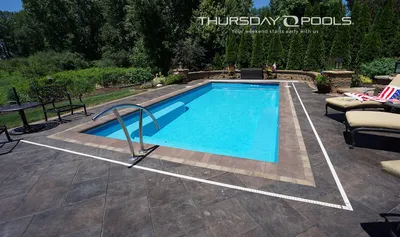
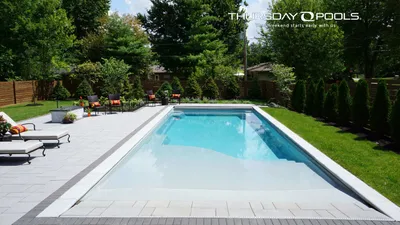
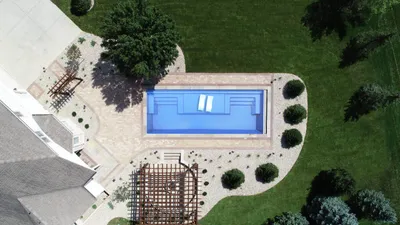
The rectangle is the most popular pool shape, and for good reason. It is clean, efficient, and versatile.
Pros
- Best use of space. Every corner of a rectangular pool is usable swimming area. There are no curved gaps or wasted pockets. On a narrow lot, this matters a lot.
- Ideal for lap swimming. The straight walls let you push off cleanly and swim in a straight line. If exercise is part of why you want a pool, a rectangle is the practical choice.
- Clean sight lines. Rectangular pools pair naturally with modern and traditional patio designs. The straight edges create a sense of order that makes the whole backyard feel intentional.
- Fits narrow lots. A 10 x 24 or 12 x 28 rectangle fits on lots as narrow as 35 feet (after setbacks). The straight sides sit parallel to property lines, maximizing the usable width. For more on fitting pools into tight spaces, see our small backyard guide.
- Easy to cover. Safety covers, solar blankets, and automatic covers all fit rectangular pools with minimal customization.
Cons
- Can look plain. A rectangle is simple by definition. If you want a pool that looks like a natural lagoon or a resort feature, a rectangle may feel too utilitarian.
- Sharp corners. The 90-degree corners can be a concern for some families with young children, though this is more of a perception issue than a real safety issue. The corners are smooth in fiberglass pools.
Best for
Narrow lots, lap swimmers, modern home styles, homeowners who value clean aesthetics and efficient use of space.
What about freeform pools?
Freeform pools have curved, organic shapes with no straight edges. They are designed to look like natural bodies of water, as if they belong in the landscape rather than being placed in it.
Pros
- Natural appearance. Freeform pools blend with landscaping beautifully. Surrounded by stone, plantings, and water features, they can look like a natural pond or lagoon.
- Works well with irregular yards. If your yard has odd angles, slopes, or an unusual shape, a freeform pool can follow the contours of the land more naturally than a rectangle.
- Visual interest. The curves create different perspectives from different angles. A freeform pool looks different from the patio, the house, and the garden, which gives the backyard a sense of depth.
- Hides equipment areas. The irregular shape can create natural nooks and corners where equipment pads, planting beds, or water features tuck in without looking out of place.
Cons
- Uses space less efficiently. The curves create irregular gaps between the pool edge and fences or property lines. These gaps are often too narrow for furniture but too wide to ignore. On a small lot, this wasted space is noticeable.
- Not great for lap swimming. You cannot swim a straight line in a freeform pool. For casual swimming and playing, this does not matter. For exercise, it is frustrating.
- Harder to cover. Safety covers for freeform pools are custom-made and cost more. Automatic covers are more difficult to engineer for curved shapes.
- Patio planning is harder. Irregular pool edges create irregular patio shapes, which can be awkward to furnish. Where do you put a rectangular dining table next to a curved pool edge?
Best for
Larger lots, natural landscaping styles, homeowners who prioritize the look and feel of the backyard over swimming efficiency.
What about Roman pools?
A Roman pool has a rectangular body with semicircular (rounded) ends on one or both sides. It splits the difference between the clean efficiency of a rectangle and the softer look of curves.
Pros
- Best of both worlds. The straight sides give you efficient use of space and decent lap swimming, while the rounded ends soften the overall look. It feels less rigid than a pure rectangle without sacrificing much practicality.
- Classic aesthetic. The Roman shape has been used in pool design for decades. It suits traditional, Mediterranean, and transitional home styles well.
- Steps fit naturally. The rounded ends are a natural place for entry steps, which keeps the straight sides free for swimming.
Cons
- Takes up more space. The rounded ends extend the pool's footprint beyond what a pure rectangle would need. On a tight lot, those extra few feet matter.
- Fewer fiberglass options. Not as many fiberglass manufacturers offer true Roman shapes as offer rectangles. Your model selection may be more limited.
- Cover fit. The rounded ends make automatic covers slightly more complex, though it is still manageable since the sides are straight.
Best for
Homeowners who want something more interesting than a rectangle but still want clean lines and practical swimming space. Works well with traditional home styles.
What about L-shaped pools?
An L-shaped pool has two rectangular sections joined at a right angle, creating a distinct shape that divides the pool into two zones.
Pros
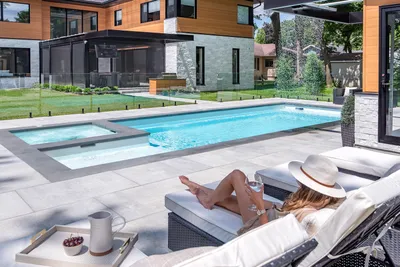
- Natural zone separation. The L-shape naturally creates two distinct areas. The shorter arm of the L can serve as a shallow play area for kids or a lounging zone, while the longer arm is used for swimming. This separation happens without any physical barrier.
- Fits corner lots well. If your best pool location is in a corner of the yard, an L-shape can wrap around the corner and use space that would be awkward for a rectangle.
- Looks distinctive. L-shaped pools stand out visually. They create interesting patio layouts with a natural nook in the inside corner of the L that is perfect for a table or lounge area.
Cons
- Larger footprint. An L-shaped pool takes up more total yard space than a rectangular pool with the same water area. The shape spreads out in two directions.
- More complex to cover. Safety covers and automatic covers are significantly more complex and expensive for L-shaped pools.
- Limited fiberglass options. Fewer manufacturers make L-shaped fiberglass models. If you want this shape in fiberglass, your choices are more limited. Concrete gives you more flexibility.
- Not ideal for narrow lots. The L-shape needs width in two directions, which does not work on a narrow suburban lot.
Best for
Larger yards, families who want separate zones for kids and adults, corner lot layouts where the yard wraps around the house.
What about kidney-shaped pools?
A kidney-shaped pool has an indented curve on one side, creating a bean-like shape. It was one of the most popular pool shapes in the 1960s through 1980s and is still available today.
Pros
- Familiar look. The kidney shape is iconic. Many homeowners grew up swimming in kidney-shaped pools and have a nostalgic connection to the shape.
- The indentation creates a natural nook. The concave side of the kidney is a natural spot for a patio area, seating, or a diving board. It creates an enclosed feeling on one side of the pool.
- Softer than a rectangle. The curves give a kidney pool a more relaxed feel than a rectangle without going fully freeform.
Cons
- Less efficient than a rectangle. The curved shape does not use yard space as efficiently as straight sides.
- Dated perception. Some homeowners associate kidney shapes with older pools. This is entirely a style preference, but it is worth mentioning.
- Harder to cover. Like all curved shapes, kidney pools require custom covers.
- Limited fiberglass selection. Kidney shapes are less common in modern fiberglass manufacturing than rectangles and freeforms.
Best for
Homeowners who like the classic kidney look, yards with enough space to accommodate the curves, situations where the concave side creates a useful patio nook.
What about geometric pools with radius corners?
A geometric pool with radius corners is essentially a rectangle where the sharp 90-degree corners have been softened into gentle curves. The sides are still straight, and the overall shape is still rectilinear, but the corners are rounded.
Pros
- All the benefits of a rectangle. Straight sides, efficient space use, good for lap swimming, easy to cover.
- Softer visual feel. The rounded corners take away the rigidity of a pure rectangle without changing the functional shape. It is a subtle difference but one that many homeowners prefer.
- Popular in fiberglass. Many fiberglass manufacturers use radius corners on their rectangular models as a standard design element. You often do not have to request it specifically.
- Comfortable corners. The rounded corners are more comfortable to sit in or lean against than sharp 90-degree angles.
Cons
- Very similar to a rectangle. If you are looking for a shape that makes a visual statement, radius corners may be too subtle to notice. From a few feet away, it looks like a rectangle.
Best for
Anyone who would choose a rectangle but wants it to feel slightly less rigid. This is a popular default choice in fiberglass pool design.
How do all the shapes compare?
| Shape | Space Efficiency | Lap Swimming | Visual Appeal | Cover Ease | Best Lot Type |
|---|---|---|---|---|---|
| Rectangle | Excellent | Excellent | Clean, modern | Easy | Any, esp. narrow |
| Freeform | Fair | Poor | Natural, organic | Hard | Large, irregular |
| Roman | Good | Good | Classic, elegant | Moderate | Medium to large |
| L-Shape | Fair | Fair | Distinctive | Hard | Large, corner lots |
| Kidney | Fair | Fair | Classic, familiar | Hard | Medium to large |
| Geometric (radius) | Excellent | Excellent | Softened modern | Easy | Any, esp. narrow |
Which shapes are available in fiberglass?
Fiberglass pools are manufactured in moulds, so you are limited to the shapes each manufacturer offers. That said, the variety has expanded significantly in recent years.
Here is a general sense of shape availability in fiberglass:
| Shape | Fiberglass Availability |
|---|---|
| Rectangle / Geometric | Very common, many models and sizes |
| Freeform | Common, good selection from most brands |
| Roman | Moderate, available from some brands |
| L-Shape | Limited, fewer manufacturers offer this |
| Kidney | Limited, less common in modern lines |
If you want a specific shape, start by checking whether it is available in the fiberglass models your installer carries. If the shape you want is not available in fiberglass, concrete construction offers unlimited shape flexibility but at a higher cost and longer build time.
Most fiberglass manufacturers offer each shape in several sizes, from compact (10 x 20 feet) to large (16 x 36 feet). Within each shape category, you can often find models with or without tanning ledges, built-in bench seating, and different step configurations.
How does your lot shape affect the pool shape?
Your lot shape is often the most important factor in choosing a pool shape. Here are the common scenarios:
Narrow lots (35 to 45 feet wide)
Rectangle or geometric with radius corners. The straight sides maximize the usable width. A freeform shape on a narrow lot wastes too much space in the curves.
Wide lots (50+ feet wide)
Any shape works. You have enough room for curves, L-shapes, or a large rectangle with generous patio on all sides.
Deep but narrow lots
A long, narrow rectangle (10 x 28 or 12 x 30) uses the depth of the lot while keeping the width manageable. This is common in London subdivisions where lots are 40 feet wide but 120 feet deep.
Irregular or pie-shaped lots
Freeform pools can follow the odd angles of an irregular lot better than rigid shapes. If your lot widens or narrows toward the back, a freeform shape may fit more naturally.
Corner lots
L-shaped pools can wrap around the corner of the house, using two sides of the yard effectively. A rectangle positioned diagonally is another option, though less common.
How do you choose the right shape?
Start with your lot, not with a shape you saw online. Measure your available space (or have your installer do it) and figure out what actually fits within your setback requirements.
Then think about how you will use the pool:
- If swimming laps matters, lean toward a rectangle.
- If a natural, landscaped look matters, lean toward freeform.
- If you want something in between, look at Roman or geometric with radius corners.
- If you want separate zones (kids area and swim area), consider an L-shape or a model with a built-in tanning ledge.
Finally, think about practical considerations: do you want a safety cover? Rectangles are easiest and cheapest to cover. Do you have a small lot? Rectangles use space best. Is your yard irregularly shaped? Freeform might fit better.
There is no wrong answer. Every shape has trade-offs. The right shape is the one that fits your yard, matches how you will use the pool, and looks the way you want it to look.
If you are still unsure, browse pool models on the pool models page and see which shapes catch your eye. Then have your installer visit your property and tell you which of those options will actually work in your yard. Sometimes the shape you started with works. Sometimes the installer suggests something different that fits better. Either way, the conversation is easier once you understand what each shape brings to the table.
Frequently Asked Questions
What is the most popular pool shape?
Rectangular pools are the most popular shape overall, and they are the most common choice for fiberglass pools in Ontario. They use space efficiently, work well on narrow subdivision lots, are ideal for lap swimming, and pair cleanly with modern patio designs. Freeform shapes are the second most popular choice, especially for homeowners who want a more natural, landscaped look.
What pool shape is best for a narrow lot?
A rectangle is the best shape for a narrow lot because it uses every inch of available width. The straight sides sit parallel to property lines and fences, leaving the maximum possible space for patio on the sides. A 10 or 12-foot wide rectangle fits well on lots as narrow as 35 feet after accounting for setback requirements.
What is the difference between a Roman and rectangular pool?
A Roman pool has a rectangular body with semicircular (rounded) ends on one or both sides. The main body gives you the same clean lines and efficient space use as a rectangle, while the rounded ends add visual interest and soften the overall look. Roman pools take up slightly more space than a pure rectangle of the same length because of the curved ends.
Are freeform pools more expensive than rectangular pools?
In fiberglass, the price difference between freeform and rectangular pools is minimal because both are manufactured shells. The price depends more on the overall size of the pool than the shape. In concrete construction, freeform pools can cost more because the custom curves require more forming work on site. The bigger cost difference is in the patio, where irregular pool edges often require more cutting and fitting of patio materials.
Can you get an L-shaped fiberglass pool?
Yes, several fiberglass manufacturers offer L-shaped models. These are moulded as a single piece with the L-shape built in. The selection is more limited than rectangular or freeform options because L-shapes are a more specialized design. If you want a true L-shape, check with your installer about which manufacturer models are available in that configuration.