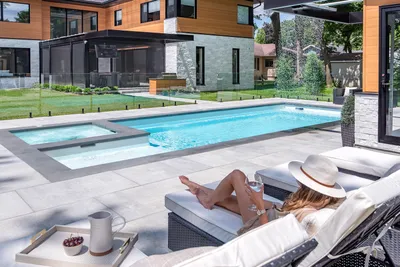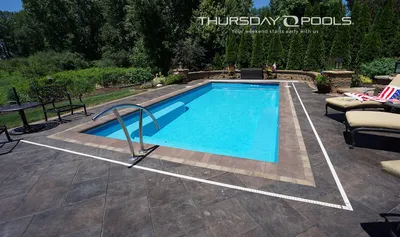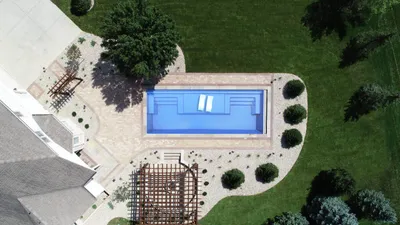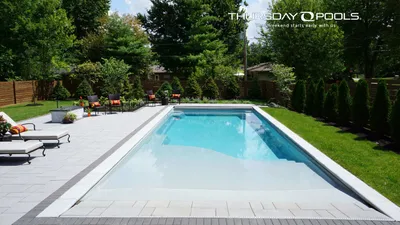
Tanning ledges have become one of the most requested pool features in the last several years. Scroll through any pool company's Instagram and you will see them everywhere: in-pool loungers sitting on a shallow shelf, water gently rippling around them.
They look great in photos. But are they actually worth it once you live with one? That is the question this article answers honestly.
We install pools with and without tanning ledges, and we hear feedback from homeowners on both sides. Some people say it is their favourite part of the pool. Others wish they had used that space for more swimming area. The right choice depends on how you use your pool.
What exactly is a tanning ledge?
A tanning ledge (also called a sun shelf, Baja shelf, or sun deck) is a large, flat, shallow area built into the pool. It is typically 5 to 8 feet wide and runs across part of one end of the pool. The water depth on a tanning ledge is usually 6 to 10 inches.
The idea is simple: you place in-pool lounging chairs (often called ledge loungers) on the shelf and lie in the sun with a few inches of water covering your legs. It is like being on the beach, but in your pool.
In fiberglass pools, the tanning ledge is moulded directly into the pool shell. It is not something you add later. You choose a pool model that has a tanning ledge built in, or you choose one without. This is an important distinction because it means the decision happens before the pool is ordered, not during installation.
Some tanning ledges are at one end of the pool (the most common layout), while others run along one side. The position affects how much swimming area remains and how the pool fits into your patio layout.
How much does a tanning ledge cost?
Because the tanning ledge is built into the fiberglass shell, it is not priced as a separate add-on. Instead, pool models with tanning ledges tend to cost more than similar-sized models without one.
| Item | Cost (CAD) |
|---|---|
| Price difference for a model with tanning ledge vs without | $2,000 – $5,000 |
| In-pool ledge lounger (each) | $300 – $800 |
| In-pool side table | $150 – $400 |
| Bubblers or water features on ledge | $500 – $1,500 |
Most homeowners put two ledge loungers and a small side table on their tanning ledge, which adds about $800 to $2,000 to the project for furniture alone.
Some homeowners also add bubblers (small water jets that shoot up from the ledge surface) for visual appeal and a gentle splashing sound. Bubblers require plumbing during installation, so they need to be planned in advance.
All in, choosing a pool model with a tanning ledge and furnishing it properly adds roughly $3,000 to $7,000 CAD to a pool project compared to a similar model without one. For a full breakdown of pool project costs, see our cost guide.
What are the pros of a tanning ledge?
It is the most-used part of the pool
This is what homeowners tell us consistently. On a typical summer day, people spend more time on the tanning ledge than swimming. It is the place where you sit with a drink, read a book, chat with someone on the patio, or just lie back and soak up the sun. Swimming is active. The tanning ledge is relaxation.
It works well for young children
The shallow water on a tanning ledge gives toddlers and small children a place to play in the pool without being in deep water. Kids can sit, splash, and play with water toys in 6 to 10 inches of water. This is not a substitute for supervision (you always need to watch children near water), but it does give young families a more comfortable option than the deep end.
It looks great
There is no getting around it: a tanning ledge with a couple of loungers looks beautiful. The shallow water catches the light differently than the deeper pool, creating a visual contrast that makes the whole pool more interesting to look at. If the aesthetic of your backyard matters to you, a tanning ledge adds a lot.
It extends how you use the pool
Not everyone wants to swim every time they go out to the pool. A tanning ledge gives you a way to be in the water without being in the water, if that makes sense. You can sit on the ledge in your clothes and just dangle your feet. You can lie on a lounger with a book and barely get wet. It lowers the barrier to using the pool on days when you do not feel like a full swim.
It provides a gradual entry point
Some tanning ledges double as a beach entry or gradual-slope entry into the pool. Instead of walking down steps into deep water, you walk onto the shallow ledge first and then step off into the deeper area. This is more comfortable for people who are less confident in the water or who have mobility concerns.
What are the cons of a tanning ledge?
It reduces swimming area
This is the biggest trade-off. A tanning ledge takes up a portion of the pool that could otherwise be deeper water. In a 12 x 24-foot pool, a tanning ledge might occupy 15% to 20% of the total footprint. That is real swimming space you are giving up.
If your family is primarily interested in swimming laps, playing pool games, or exercising in the water, the tanning ledge takes away from that. You cannot swim through a tanning ledge. It is dead space for anyone who wants to be in deep water.
It collects debris
The shallow water on a tanning ledge does not circulate as well as the rest of the pool. Leaves, pollen, sand, and dirt tend to settle on the ledge surface because the water is not moving fast enough to carry debris to the skimmer.
Most tanning ledge owners find they need to brush or rinse the ledge once or twice a week during peak season. It is not a major chore, but it is extra maintenance compared to a pool without a ledge. Adding a return jet directed at the ledge can help, but it will not eliminate the issue entirely.
Algae can grow on the surface
The shallow water on a tanning ledge warms up faster than the deeper pool water. Warmer water plus more sunlight exposure equals a more favourable environment for algae growth. The gel coat surface of a fiberglass pool resists algae well, but the tanning ledge is still the area most likely to show green if your chemistry is off.
Regular brushing and proper chemical balance prevent this, but it is something to be aware of.
Furniture can be expensive
Ledge loungers and in-pool furniture are specialty items. You cannot use regular patio furniture on a tanning ledge because it will float, rust, or scratch the gel coat. Purpose-built in-pool furniture is made from UV-resistant, pool-safe materials, and it is priced accordingly.
A pair of quality ledge loungers runs $600 to $1,600 CAD. They hold up well over time, but the initial cost surprises some homeowners who assumed they could just use regular chairs.
It makes the pool feel smaller
In a compact pool (say, 10 x 20 feet), a tanning ledge can make the remaining swimming area feel noticeably small. You end up with a nice lounging area but a swimming area that feels more like a large hot tub. For small backyards, this trade-off is worth thinking about carefully.
Tanning ledge vs no tanning ledge: side-by-side
| Factor | With Tanning Ledge | Without Tanning Ledge |
|---|---|---|
| Swimming area | Reduced by 15 – 20% | Full pool is swimmable |
| Lounging in water | Built-in with furniture | Sit on steps or edge only |
| Young kids area | Shallow wading area | Steps are the shallowest area |
| Maintenance | Extra brushing needed | Standard maintenance |
| Debris collection | More debris on ledge | Debris goes to skimmer |
| Visual appeal | Very attractive feature | Clean, simple look |
| Cost premium | $3,000 – $7,000 more | Baseline cost |
Who are tanning ledges best for?
Tanning ledges work best for homeowners who:
- Use the pool more for relaxing than for swimming. If your typical pool day involves sitting by the water, reading, socializing, and occasionally cooling off, a tanning ledge fits that lifestyle perfectly.
- Have young children. The shallow area gives small kids a safe (but still supervised) place to play. Many families say this is the main reason they chose a tanning ledge.
- Entertain often. When you have people over, the tanning ledge becomes a social hub. People who might not want to swim will sit on the ledge with their feet in the water. It brings more people into the pool area.
- Have a medium to large pool. In a 14 x 30 or 16 x 36 pool, the tanning ledge takes up a smaller percentage of the total area. You still have plenty of swimming space.
- Value the look. If the visual appeal of your backyard is important to you, a tanning ledge with loungers adds a resort-like quality that a plain pool does not have.
Who should skip the tanning ledge?
A tanning ledge is probably not the best choice if:
- You primarily want to swim. If lap swimming, water exercise, or playing pool games is how you use the pool, every square foot of deep water matters. The tanning ledge takes that away.
- You have a very small pool. In a 10 x 20 pool, a tanning ledge could take up 25% or more of the total area. The remaining swimming space may feel cramped.
- You do not want extra maintenance. If you want the simplest, lowest-maintenance pool experience possible, a pool without a tanning ledge is easier to keep clean.
- You are very budget-conscious. The $3,000 to $7,000 cost premium (including furniture) can be put toward other things like a better heater, a larger patio, or a nicer patio material.
How do tanning ledges work in fiberglass pools?
In a fiberglass pool, the tanning ledge is part of the pool shell. It is manufactured as one continuous piece with the rest of the pool. You cannot add a tanning ledge to a fiberglass pool after installation.
This means the decision to include a tanning ledge happens during the pool selection process. When you browse pool models from manufacturers like Thursday Pools, you will see that some models include a tanning ledge and others do not. Often, the same basic pool shape is available in versions with and without a ledge.
The integrated design is actually one of the advantages of fiberglass tanning ledges. Because the ledge is part of the same gel coat surface as the rest of the pool, there are no seams, joints, or separate pieces that could leak or shift over time. The smooth, one-piece construction also means the ledge surface resists algae just as well as the rest of the pool.
In concrete pools, tanning ledges are built on-site during construction, which offers more flexibility in size and placement but also means more potential for cracking and repair needs over time.
What furniture do you need for a tanning ledge?
A bare tanning ledge is just a shallow flat area. The furniture is what makes it usable and comfortable.
The most common setup is two in-pool loungers and a small side table. Here is what to look for:
- Ledge loungers. Purpose-built lounging chairs designed for 6 to 10 inches of water. They sit flat on the ledge surface and are heavy enough not to float. Made from UV-resistant, pool-safe resin or composite. Budget $300 to $800 each for quality loungers.
- In-pool side tables. Small tables that sit on the ledge to hold drinks, sunscreen, or a book. $150 to $400 each.
- In-pool umbrellas. Some ledge furniture systems include an umbrella stand that anchors in the ledge. Useful for shade on hot days. $200 to $500 for the stand, plus the umbrella.
Do not use regular patio furniture on a tanning ledge. Metal furniture will rust and stain the gel coat. Wood furniture will degrade and clog the filter. Cheap plastic chairs will float off the ledge. Use furniture specifically designed for in-pool use.
One tip: some pool owners skip the furniture and just use the ledge as a wading and sitting area. You can sit directly on the smooth gel coat surface with the water around you. It is not as comfortable as a lounger, but it works fine for a casual dip.
How do you maintain a tanning ledge?
Tanning ledge maintenance is straightforward, but it is a bit more work than the rest of the pool.
- Brush the surface weekly. Use a soft pool brush to sweep debris off the ledge surface and into the deeper water where it can be picked up by the skimmer or main drain.
- Check for algae spots. The shallow, sun-exposed water on the ledge is the first place algae will appear if your chemistry drifts. A quick visual check when you brush will catch any issues early.
- Move the furniture occasionally. Shift the loungers and table once a week to brush underneath them. Debris and algae can accumulate under furniture that sits in the same spot all season.
- Consider adding a return jet. If your pool model allows it, having a return jet directed at the tanning ledge improves water circulation across the shallow area and reduces debris buildup.
Total extra maintenance time for a tanning ledge is roughly 5 to 10 minutes per week. It is not a burden, but it is worth knowing about before you commit.
The bottom line
Tanning ledges are genuinely popular for good reason. They change how people use their pool, turning it from just a place to swim into a place to relax, socialize, and spend time outdoors. Most homeowners who get one are happy with the decision.
But they are not free. You give up swimming space, you take on a bit more maintenance, and you spend $3,000 to $7,000 more than you would without one. For homeowners who prioritize swimming over lounging, or who are working with a very compact pool, the trade-off may not make sense.
The best way to decide is to think honestly about how you use your pool on a normal Tuesday afternoon, not a special occasion. If the answer is "I would mostly sit on the ledge with a drink and maybe swim a few lengths," a tanning ledge is probably worth it. If the answer is "I would swim 20 laps after work," you probably want every inch of deep water you can get.
Both are valid. The worst outcome is choosing a tanning ledge because it looks good on Instagram and then wishing you had more swimming space, or skipping it because it seemed unnecessary and then spending every summer wishing you had a place to lounge in the water.
Frequently Asked Questions
What is a tanning ledge in a pool?
A tanning ledge (also called a sun shelf or Baja shelf) is a wide, flat, shallow area built into the pool, typically 6 to 10 inches deep. It is designed for placing lounge chairs in the water, wading, or sitting with just a few inches of water around you. In fiberglass pools, the tanning ledge is moulded into the pool shell as part of the original design.
How much does a tanning ledge add to the cost of a fiberglass pool?
In fiberglass pools, the tanning ledge is built into the pool shell, so it does not add a separate cost. However, pool models with tanning ledges tend to cost $2,000 to $5,000 more than similar-sized models without one, because the shell is larger and more complex to manufacture. You also need to budget for in-pool furniture like ledge loungers, which run $300 to $800 each.
Do tanning ledges reduce swimming space?
Yes. A tanning ledge takes up a portion of the pool's total footprint that could otherwise be deeper water for swimming. In a 12 x 24-foot pool, a tanning ledge might occupy 15% to 20% of the total water area. This is worth considering if swimming laps or having maximum deep water is your priority.
Are tanning ledges safe for small children?
Tanning ledges can be a useful shallow play area for toddlers and small children because the water is only 6 to 10 inches deep. However, they are not a substitute for adult supervision. Children can still slip on the wet surface, and the ledge creates a step-off point where the pool suddenly gets deeper. Never leave children unattended near or in any pool area, including a tanning ledge.
Do tanning ledges collect debris?
Yes. The shallow water on a tanning ledge does not circulate as actively as the deeper parts of the pool, which means leaves, pollen, and dirt tend to settle on the ledge surface. Most homeowners find they need to brush or rinse the ledge once or twice a week during peak season. Adding a return jet near the ledge can help improve circulation, but some debris collection is normal.