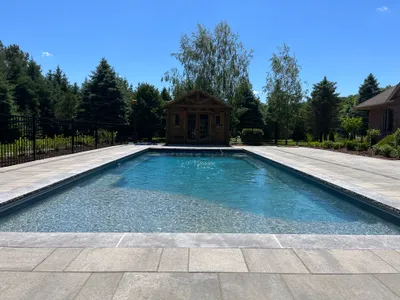
Before buying a pool, most people research the upfront cost. Fewer people think about what the pool costs to run every year after it is installed. The annual cost is not enormous, but it is real, and it helps to know the numbers before you commit.
The good news is that fiberglass pools are the cheapest type of inground pool to maintain. The smooth gel coat surface resists algae, uses fewer chemicals, and never needs resurfacing. That adds up to meaningful savings over the years compared to concrete or vinyl liner pools.
What is the full cost breakdown?
Here is what a typical year of pool ownership costs for a fiberglass pool in Ontario:
| Annual Cost Category | Range (CAD) |
|---|---|
| Chemicals (chlorine, pH, alkalinity, shock) | $250 - $500 |
| Electricity (variable-speed pump) | $150 - $350 |
| Water (initial fill + top-ups) | $75 - $175 |
| Opening and closing (hired out) | $500 - $800 |
| Heating (gas or heat pump) | $400 - $1,200 |
| Total without heating | $1,000 - $1,500 |
| Total with heating | $1,500 - $3,000 |
The biggest variable is heating. If you do not heat your pool, annual costs stay in the $1,000 to $1,500 range. If you heat with a gas heater regularly, the total can push toward $3,000. A heat pump keeps heating costs lower, usually $200 to $600 per season.
How much do pool chemicals cost per year?
Pool chemicals are the ongoing consumable cost of owning a pool. You need to maintain the right balance of sanitizer, pH, and alkalinity to keep the water safe and clear.
For a fiberglass pool using a standard chlorine system, expect to spend $250 to $500 per year on chemicals. Here is the typical breakdown:
| Chemical | Annual Cost (CAD) | Purpose |
|---|---|---|
| Chlorine (tablets or liquid) | $150 - $300 | Sanitizer, kills bacteria |
| pH adjuster (muriatic acid or soda ash) | $30 - $60 | Keeps pH between 7.2 and 7.6 |
| Alkalinity increaser (sodium bicarbonate) | $20 - $40 | Stabilizes pH levels |
| Shock treatment | $30 - $60 | Periodic oxidation, clears cloudy water |
| Test strips or kit | $20 - $40 | Measures chemical levels |
| Total | $250 - $500 |
If you have a salt water system, you spend less on chlorine because the salt cell generates it automatically. You will spend about $50 to $100 per year on salt instead, plus the same pH and alkalinity chemicals. The total chemical cost with a salt system is typically $150 to $300 per year, slightly less than with traditional chlorine.
Fiberglass pools use fewer chemicals than concrete pools because the smooth gel coat surface does not harbour algae the way rough concrete does. A concrete pool owner typically spends 30% to 50% more on chemicals per year.
How much electricity does a pool use?
The pool pump is the main electricity consumer. It runs every day during swimming season (roughly May through October in Ontario) and needs to circulate the full volume of pool water at least once per day.
How much electricity the pump uses depends almost entirely on whether it is a variable-speed pump or a single-speed pump.
| Pump Type | Daily kWh | Monthly Cost (CAD) | Season Cost (6 months) |
|---|---|---|---|
| Single-speed (1.5 HP) | 10 - 16 kWh | $50 - $80 | $300 - $480 |
| Variable-speed (1.5 HP) | 3 - 6 kWh | $15 - $30 | $90 - $180 |
A variable-speed pump running at low speed for 12 to 14 hours per day uses roughly the same electricity as running a kitchen refrigerator. A single-speed pump running at full power for 8 hours per day uses three to five times as much.
Other electrical costs include pool lights (minimal) and the salt chlorine generator if you have one (adds $10 to $20 per month). The pool equipment article covers the pump comparison in more detail.
How much does the water cost?
Pools lose water through evaporation, splash-out, backwashing (if you have a sand or DE filter), and the occasional drain for maintenance. In a typical Ontario season, you will need to top up the pool several times.
A standard fiberglass pool holds 35,000 to 55,000 litres. Water in London, Ontario costs roughly $3 to $4 per 1,000 litres (including sewer charges). The initial fill costs about $100 to $200. Top-ups through the season add another $75 to $175.
Using a solar blanket significantly reduces evaporation, which is the primary source of water loss. A pool without a cover can lose 3 to 5 centimetres of water per week in hot weather. A covered pool loses much less.
What does opening and closing cost?
In Ontario, every pool must be properly closed (winterized) in the fall and opened in the spring. This is the single biggest maintenance task of the year.
Closing (winterizing)
Closing the pool typically happens in October. It involves balancing the water chemistry, lowering the water level, blowing out the plumbing lines, adding winterizing chemicals, disconnecting the equipment, and installing the winter cover. You can read our full step-by-step guide on winterizing your pool.
Opening
Opening the pool happens in late April or May. It involves removing the cover, reconnecting the equipment, filling the pool to the proper level, running the pump, balancing the chemicals, and shocking the water.
Costs
| Service | DIY Cost (CAD) | Hired Out (CAD) |
|---|---|---|
| Spring opening | $50 - $100 (chemicals only) | $250 - $400 |
| Fall closing | $50 - $100 (chemicals + antifreeze) | $250 - $450 |
| Total | $100 - $200 | $500 - $800 |
Most first-time pool owners hire a professional for the first year or two to learn the process. After watching it done, many switch to doing it themselves. The closing is the more critical of the two, because mistakes can lead to freeze damage in the plumbing or equipment.
What does it cost to heat the pool?
Heating is optional but very popular in Ontario. Without a heater, the pool is comfortable from roughly late June through early September. With a heater, you can extend that by six to ten weeks.
| Heater Type | Annual Running Cost (CAD) |
|---|---|
| Gas heater (regular use) | $400 - $1,200 |
| Heat pump (continuous use) | $200 - $600 |
| Solar blanket only | $0 (one-time purchase $100 - $300) |
The running cost of a gas heater depends heavily on usage. A homeowner who heats the pool every day from May to October will spend more than someone who only heats for weekends. A heat pump costs less to run because it moves heat from the air rather than generating it from gas. Our full breakdown is in the pool heaters guide.
What does the weekly maintenance routine look like?
Weekly pool maintenance takes about 30 to 45 minutes once you know what you are doing. Here is a typical routine:
- Skim the surface (5 minutes). Use a leaf net to remove any floating debris, leaves, or bugs.
- Empty the skimmer basket (2 minutes). Pull out the basket, dump it, and put it back.
- Empty the pump strainer basket (5 minutes). Turn off the pump, open the strainer lid, empty the basket, close the lid, and restart the pump.
- Test the water (5 minutes). Use test strips or a liquid test kit to check chlorine, pH, and alkalinity.
- Add chemicals as needed (5 minutes). Adjust chlorine, pH, or alkalinity based on the test results.
- Brush the walls and floor (10 minutes). Use a pool brush to loosen any film on the walls and push debris toward the main drain.
- Vacuum or run the robotic cleaner (10 to 30 minutes). Manual vacuuming takes time. A robotic cleaner runs on its own and takes no effort.
Most homeowners get into a routine of testing and adding chemicals twice per week and doing a full clean (brushing, vacuuming, baskets) once per week.
Should you do maintenance yourself or hire someone?
Both are reasonable options. Here is what each costs:
| Option | Annual Cost (CAD) | Your Time |
|---|---|---|
| Full DIY (weekly + opening/closing) | $400 - $900 | 30-45 min/week + 2-4 hrs twice/year |
| DIY weekly + hired opening/closing | $750 - $1,300 | 30-45 min/week |
| Hired weekly service + opening/closing | $2,000 - $4,000 | None |
A weekly pool service in London, Ontario typically costs $150 to $250 per month during swimming season (5 to 6 months). That covers testing, chemical adjustments, skimming, brushing, and vacuuming.
Most pool owners we work with start by doing it themselves. The weekly routine is straightforward, and most people find it takes less time than they expected. The learning curve is steepest in the first few weeks, but by midsummer, it becomes second nature.
How does fiberglass maintenance compare to concrete?
Fiberglass pools are significantly cheaper and easier to maintain than concrete pools. The difference comes down to the surface material.
| Maintenance Category | Fiberglass | Concrete |
|---|---|---|
| Annual chemical cost | $250 - $500 | $400 - $800 |
| Algae treatment | Rare (smooth surface resists algae) | Frequent (rough surface harbours algae) |
| Brushing | Once per week, light | 2-3 times per week, heavy |
| Acid washing | Not needed | Every 3-5 years ($500 - $1,000) |
| Resurfacing | Not typically needed | Every 10-15 years ($15,000 - $30,000) |
| Annual total (no heating) | $1,000 - $1,500 | $2,500 - $5,000 |
| 25-year maintenance cost | $25,000 - $50,000 | $75,000 - $150,000+ |
The biggest long-term difference is resurfacing. Concrete pools need to be resurfaced every 10 to 15 years, which costs $15,000 to $30,000 each time. Fiberglass pool surfaces do not degrade the same way and typically never need resurfacing. Over 25 years, this saves $30,000 to $60,000.
The smooth gel coat on a fiberglass pool is also much gentler on your feet, your swimsuits, and your vacuum equipment. It does not harbour the algae or bacteria that concrete's rough, porous surface does.
How can you reduce pool maintenance costs?
There are several practical ways to keep your annual costs at the lower end of the range:
- Use a solar blanket. A $100 to $300 solar blanket reduces evaporation (saving water and chemicals), retains heat (cutting heating costs by up to 50%), and keeps debris out of the pool (less skimming and vacuuming).
- Install a variable-speed pump. If you are still running a single-speed pump, switching to a variable-speed model saves $500 to $800 per year in electricity. The pump pays for itself in 1 to 2 years.
- Insulate the pool shell. Spray foam insulation applied around the pool shell during installation helps retain heat in the water. This reduces how much the heater needs to run and how quickly the pool loses heat overnight.
- Test and adjust chemicals regularly. Small, frequent adjustments cost less and work better than large corrections after the water has gotten out of balance. Neglecting the water for two weeks can lead to an algae bloom that costs $50 to $100 in shock treatment to fix.
- Do your own opening and closing. Learning to open and close the pool yourself saves $500 to $800 per year. Have a professional show you the process the first time.
- Choose a heat pump over a gas heater. A heat pump costs $200 to $600 per year to run. A gas heater costs $400 to $1,200. Over 10 years, that is a significant difference.
- Use a robotic pool cleaner. A one-time purchase of $1,000 to $2,500 eliminates the need for manual vacuuming and keeps the pool cleaner, which means fewer chemical corrections.
What unexpected costs should you plan for?
Beyond the predictable annual costs, there are a few things that come up occasionally:
| Item | Cost (CAD) | How Often |
|---|---|---|
| Filter cartridge replacement | $150 - $400 | Every 2 - 4 years |
| Salt cell replacement | $800 - $1,200 | Every 3 - 7 years |
| Winter cover replacement | $300 - $800 | Every 5 - 8 years |
| Pump motor repair | $300 - $600 | Occasionally |
| Heater service or repair | $200 - $500 | Occasionally |
| Solar blanket replacement | $100 - $300 | Every 3 - 5 years |
None of these are annual expenses, but they are worth budgeting for. Setting aside $200 to $300 per year into a "pool fund" covers these occasional costs comfortably.
What does it really add up to?
Here is the honest summary for a fiberglass pool owner in Ontario who does their own weekly maintenance, hires out the opening and closing, and uses a heat pump:
| Category | Annual Cost (CAD) |
|---|---|
| Chemicals | $350 |
| Electricity (variable-speed pump) | $200 |
| Water | $125 |
| Opening and closing | $650 |
| Heating (heat pump) | $400 |
| Occasional replacements (averaged) | $250 |
| Typical total | $1,975 |
For a family that gets 18 to 22 weeks of swimming per year, that works out to roughly $90 to $110 per week of pool use. That is less than what most families spend on a single day at a water park or a weekend at a cottage rental.
Frequently Asked Questions
How much does it cost to maintain a pool per year in Ontario?
A fiberglass pool in Ontario costs $1,000 to $3,000 per year to maintain. Without a heater, most homeowners spend $1,000 to $1,500. With a heater, the total is $1,500 to $3,000. The main costs are chemicals ($250 to $500), electricity ($150 to $350), water ($75 to $175), and seasonal opening and closing ($500 to $800).
Is a fiberglass pool cheaper to maintain than a concrete pool?
Yes. Fiberglass pools cost roughly $1,000 to $3,000 per year to maintain, while concrete pools typically cost $2,500 to $5,000 per year. The difference is mainly due to chemicals: the smooth gel coat surface on a fiberglass pool resists algae growth, so you use fewer chemicals and spend less time on upkeep.
Can I do pool maintenance myself or should I hire someone?
Most pool owners handle weekly maintenance (testing water, adding chemicals, skimming) themselves. It takes about 30 to 45 minutes per week. Many homeowners hire a professional for opening and closing the pool ($500 to $800 per year), which involves equipment that most people do not own. Some hire a weekly service ($150 to $250 per month) for full hands-off maintenance.
What is the biggest pool maintenance cost?
For pools without a heater, the biggest annual cost is usually the seasonal opening and closing service at $500 to $800 per year. For heated pools, the heater running cost ($400 to $1,200 per year) is typically the largest expense. Chemicals are the next biggest cost at $250 to $500 per year.
How can I reduce my pool maintenance costs?
The most effective ways to reduce costs are: use a solar blanket to cut heating costs by up to 50%, install a variable-speed pump to save $500 to $800 per year on electricity, keep the water chemistry balanced to avoid expensive corrections, and learn to do weekly maintenance yourself instead of hiring a service.