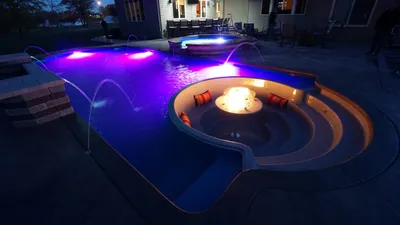
Pool lights are one of those features that seem optional until you see a pool lit up on a summer evening. After that, most homeowners decide they want them.
The good news is that LED pool lighting is more affordable, more efficient, and longer-lasting than the halogen and incandescent lights used in older pools. A pair of modern LED lights will cost a fraction of what they would have 15 years ago, and they will last for the better part of two decades.
This article covers the different types of LED pool lights available, what they cost, how they are installed in fiberglass pools, and what actually looks good once the sun goes down.
What types of pool lights are available?
There are three main types of LED pool lights used in residential fiberglass pools:
White LED lights
These produce a single colour of light, usually a clean white or slightly warm white. They are the simplest and least expensive option. A white light illuminates the pool clearly, shows off the gel coat colour, and provides good visibility for evening swims.
Colour-changing LED lights (RGB)
These lights can display multiple colours, including blue, red, green, purple, amber, and white. Most models offer pre-set colour shows that cycle through different colours automatically. You can also lock the light on a single colour. Colour-changing lights cost more upfront but give you flexibility to change the pool's look on any given night.
Nicheless LED lights
Traditional pool lights sit inside a niche (a housing built into the pool wall). Nicheless lights mount flush to the pool surface without a full niche. They are smaller, thinner, and can be placed in locations where a traditional niche will not fit. They produce less light than full-size niche lights but are useful for accent lighting or adding lights to areas like steps and tanning ledges.
| Light Type | Cost per Light (CAD) | Best For |
|---|---|---|
| White LED (niche) | $880 – $1,320 | Basic pool illumination |
| Colour-changing LED (niche) | $1,320 – $1,980 | Evening ambiance, colour variety |
| Nicheless LED | $330 – $660 | Accent lighting, steps, tight spaces |
These prices include the light fixture, niche (where applicable), wiring back to the equipment pad, and installation labour. The light fixture itself is usually $330 to $880 of the total cost. The rest is electrical work.
Should you get white or colour-changing lights?
This comes down to how you plan to use your pool in the evenings and what matters to you.
White LED lights do one thing well: they light up the pool. The water looks clear, the gel coat colour shows through, and you can see the bottom. If your main goal is safety and visibility for evening swims, white lights are perfectly good.
Colour-changing lights give you options. You can set the pool to a warm amber for a quiet evening. You can run a slow colour cycle during a party. You can set it to blue to match a calm mood or red for a festive one. Most colour-changing lights also include a white setting, so you get everything a white light offers plus the colour options.
The price difference between white and colour-changing is usually $330 to $660 per light. For most homeowners adding one or two lights, that is a $330 to $1,320 difference in the total project.
Our observation from installing pools over the years: homeowners who choose colour-changing lights use the colour features often in the first season, occasionally in the second and third seasons, and then mostly leave them on a single favourite colour or white. That does not mean they regret the choice. They still enjoy having the option. But it is worth knowing that the novelty of cycling through 12 colours does settle down.
How much do LED pool lights cost?
The total cost depends on how many lights you install and what type you choose.
| Setup | Installed Cost (CAD) |
|---|---|
| 1 white LED light | $880 – $1,320 |
| 1 colour-changing LED light | $1,320 – $1,980 |
| 2 white LED lights | $1,540 – $2,200 |
| 2 colour-changing LED lights | $2,200 – $2,750 |
| 2 nicheless accent lights (steps/ledge) | $550 – $1,100 |
When lights are installed during the initial pool construction, the wiring runs behind the pool shell before the backfill goes in. This is much simpler than trying to add lights after the pool is already in the ground and surrounded by stone. If you think you might want lights eventually, it is significantly cheaper to include them in the original build.
How are pool lights installed in a fiberglass pool?
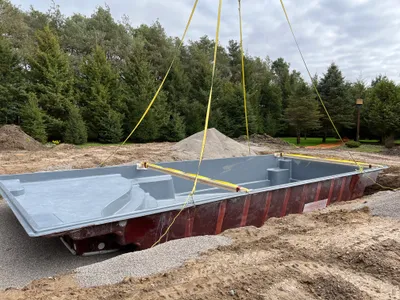
Fiberglass pool shells come from the manufacturer with pre-cut niches (openings) in the pool wall for lights. The number and location of niches depends on the pool model. Most pools have one or two light niches built in.
During installation, the process works like this:
- The light niche is already in the pool shell. It is a round or rectangular opening in the wall of the pool, usually about 12 to 18 inches below the waterline.
- The light fixture is test-fitted into the niche before the pool goes into the ground to make sure everything lines up properly.
- Electrical conduit is run from the light niche, behind the pool shell, and through the ground to the equipment pad where the transformer or panel is located.
- The pool is set and backfilled. The conduit is buried in the backfill material alongside the plumbing lines.
- The electrician connects the wiring to the transformer, switch, or automation panel.
- The light fixture is installed into the niche, sealed, and tested before the pool is filled with water.
Pool lights operate on low voltage (12V) through a transformer. This is a safety requirement. The transformer steps the household 120V power down to 12V before it reaches the light in the water. A licensed electrician handles this part of the installation.
How many lights does a pool need?
Most residential fiberglass pools use one or two lights. The right number depends on the pool size and shape.
| Pool Size | Recommended Lights | Notes |
|---|---|---|
| Small (under 25 ft) | 1 light | One light usually provides adequate coverage |
| Medium (25 – 32 ft) | 1 – 2 lights | One may be enough, two gives more even coverage |
| Large (over 32 ft) | 2 lights | Two lights recommended for even illumination |
With a single light, the end of the pool closest to the light will be brightly lit, and the far end will be dimmer. This is not necessarily a problem. Some homeowners prefer the look of one end being brighter with the other end fading into softer light. It creates a natural, less uniform look.
Two lights placed on opposite ends or opposite sides give more even coverage. The whole pool is illuminated, and there are fewer dark spots. This is better for safety if you have children who swim in the evenings.
Where should pool lights be placed?
The placement of pool lights is mostly determined by the manufacturer. The light niches are pre-cut into the pool shell at the factory, so you do not have complete freedom to put them wherever you want.
That said, there are some general principles for good pool light placement:
- Face lights away from the main seating area. You do not want to look directly into a bright underwater light while sitting on the patio. Position lights on the far wall of the pool relative to where you sit.
- Place lights in the deep end wall when possible. Deep end placement means the light shines toward the shallow end and tanning ledge, illuminating the areas where people spend the most time.
- Keep lights below the waterline. Lights are typically installed 12 to 18 inches below the water surface. Too shallow and you get surface glare. Too deep and the light does not reach as far across the pool.
- Consider accent lights for steps and ledges. Small nicheless lights on pool steps or tanning ledges add visibility in areas where people enter and exit the water.
Can you control pool lights from your phone?
Yes, if you have a pool automation system. Automation systems like Hayward OmniLogic, Pentair IntelliConnect, or Jandy iAquaLink let you control your pool lights (along with the pump, heater, and other equipment) from a smartphone app.
With automation, you can:
- Turn lights on and off from anywhere
- Change colours on colour-changing lights
- Set timers so lights come on automatically at sunset
- Dim or brighten compatible lights
- Create lighting schedules for different days of the week
A basic pool automation system costs $2,200 to $5,500 CAD installed, depending on the brand and how many devices you want to control. The automation system is not just for lights. It also controls your pump, heater, and any other connected equipment. So the cost is shared across all those functions.
Without automation, pool lights are controlled by a simple switch or timer on the equipment pad or at the house. You walk over, flip the switch, and the lights come on. It works fine. It is just less convenient than tapping your phone from a lounge chair.
How much do LED pool lights cost to run?
LED pool lights are remarkably efficient. A typical LED pool light draws 30 to 70 watts. Compare that to an old halogen pool light, which drew 300 to 500 watts.
| Light Type | Wattage | Season Cost (5 months, 5 hrs/night) |
|---|---|---|
| LED (1 light) | 30 – 70W | $8.80 – $16.50 CAD |
| LED (2 lights) | 60 – 140W | $16.50 – $33 CAD |
| Halogen (1 light, older) | 300 – 500W | $71.50 – $121 CAD |
The electricity cost of running LED pool lights is essentially negligible. Even running two colour-changing lights every evening for the entire swim season costs less than a single dinner out. This is one area where you do not need to worry about ongoing costs.
How long do LED pool lights last?
LED pool lights are rated for 30,000 to 50,000 hours of use. In Ontario, where the swim season runs roughly May through September, most homeowners run their pool lights 4 to 6 hours per evening.
At 5 hours per night for 150 nights per season (May through September), that is 750 hours per year. A 30,000-hour LED light would last about 40 seasons at that rate. Realistically, other factors like moisture, heat cycling, and component wear mean you can expect 15 to 25 years of useful life from a quality LED pool light.
That is a significant difference from older halogen lights, which lasted 2,000 to 5,000 hours and needed replacement every 2 to 5 years. LED lights cost more upfront but the long lifespan and low electricity use make them less expensive over time.
When an LED pool light does eventually fail, the light fixture can be removed from the niche and replaced without draining the pool. The niche stays in the pool wall permanently. Only the light unit itself gets swapped out.
What about landscape lighting around the pool?
Underwater pool lights are just one part of the nighttime pool experience. Many homeowners also add landscape lighting around the pool area to complete the look.
Common landscape lighting options around pools include:
- Path lights along walkways to and from the pool area ($55 to $165 each installed)
- Deck post lights on fence posts or patio pillars ($82.50 to $220 each)
- Up-lights on trees or architectural features near the pool ($110 to $275 each)
- Step lights built into patio steps or retaining walls ($82.50 to $193 each)
- String lights overhead on posts or pergolas ($220 to $550 for a run)
Landscape lighting is typically handled by a separate electrician or landscape lighting specialist. It runs on its own low-voltage transformer, separate from the pool light transformer. Planning both the pool lighting and landscape lighting together during the design phase ensures they complement each other rather than creating competing light sources.
The combination of underwater pool lights and well-placed landscape lighting creates an outdoor space that looks as good at 9 PM as it does at 2 PM. For families who use their pool area for evening entertaining, this combination makes a real difference in how the space feels after dark.
Frequently Asked Questions
How much do LED pool lights cost to install?
LED pool lights typically cost $880 to $2,750 CAD installed. A single white LED light runs about $880 to $1,320. Colour-changing LED lights cost $1,320 to $1,980 each. Most pools use one or two lights. The price includes the light fixture, niche, wiring, and installation.
Are colour-changing pool lights worth the extra cost?
Colour-changing lights cost $330 to $660 more per light than white-only LEDs. They allow you to change the pool colour at night, which many homeowners enjoy. If you use your pool in the evenings regularly, the extra cost is usually worth it. If you rarely swim after dark, a simple white light may be all you need.
How long do LED pool lights last?
LED pool lights typically last 30,000 to 50,000 hours. At 4 to 6 hours of use per day during a 5-month Ontario swim season, that works out to roughly 15 to 25 years. This is significantly longer than older halogen or incandescent pool lights, which lasted 2,000 to 5,000 hours.
Can you add pool lights to an existing fiberglass pool?
It is possible but more difficult and expensive than installing lights during the initial pool construction. The pool shell already has pre-cut niches for lights, so adding lights to a location without a niche requires specialized work. It is always easier and cheaper to include lights during the original installation.
How much electricity do LED pool lights use?
LED pool lights use very little electricity. A typical LED pool light draws 30 to 70 watts. Running two lights for 5 hours per night over a 5-month swim season costs roughly $16.50 to $33 CAD in electricity. This is about 80% less than older halogen pool lights.