Permits are not the most exciting part of a pool project, but they are one of the most important. In most Ontario municipalities, you cannot legally install a pool without one. And in the City of London specifically, the permit has to be approved before any excavation starts.
This article covers what permits you need, what they cost, how long they take, and what the fence requirements are for pool owners in London and the surrounding communities we serve.
What permits do you need for a pool in Ontario?
In Ontario, the primary permit required for a residential pool is a pool fence enclosure permit. This is not a building permit for the pool itself. It is a permit for the fence and barrier system that encloses the pool area.
The Ontario Building Code (Section 3.11) requires every outdoor pool with a water depth of 600 mm (about 2 feet) or more to be enclosed by a fence or barrier that meets specific requirements. Municipal bylaws enforce this at the local level, and each municipality handles the permit process slightly differently.
Depending on your municipality and the scope of your project, you may also need:
- A building permit if you are adding a deck, pergola, or other structure alongside the pool.
- An electrical permit for the pool equipment hookup. Your electrician typically pulls this permit separately.
- A plumbing permit in some municipalities, though this is less common for residential pools.
- A site alteration permit if your project involves significant grading changes or is near a watercourse or environmentally sensitive area.
For a standard fiberglass pool installation with a patio and fence, the pool fence enclosure permit is the main one. Your pool company should know which permits are needed for your specific situation and municipality.
What does the City of London require?
The City of London is clear about one thing: the pool fence enclosure permit must be approved before any pool installation work begins. Not during. Not after. Before.
Here is how the City of London's process works:
- You submit a pool fence enclosure permit application to the City's building division.
- The application includes a site plan showing the pool location, fence location, gate locations, and property lines.
- The building department reviews the application against the Ontario Building Code and City of London bylaws.
- Once approved, you can begin the pool installation and fence construction.
- After the fence is installed, the City sends an inspector to verify it meets code requirements.
- The pool cannot be filled with water until the fence passes inspection.
The requirement for the permit to be approved before excavation starts is the part that catches some homeowners off guard. If you sign a contract with a pool company in April and plan to be swimming by July, the permit timeline needs to be factored in from the start.
How much does a pool permit cost?
Pool permit fees vary by municipality. Here is a general overview of what you can expect in the communities we serve:
| Municipality | Permit Fee Range (CAD) | Notes |
|---|---|---|
| City of London | $500 – $1,000 | Pool fence enclosure permit |
| Middlesex Centre (Komoka, Ilderton) | $400 – $800 | Check with township office |
| Strathroy-Caradoc | $400 – $800 | Separate fence and pool permits may apply |
| St. Thomas | $400 – $700 | Pool enclosure permit |
| Thames Centre (Dorchester) | $400 – $700 | Check with township office |
These fees can change from year to year. Always check with your local building department for the current fee schedule. Some municipalities also charge a separate fee for the inspection.
If your project requires additional permits (electrical, deck, etc.), each of those has its own fee. The total permit cost for a full pool project with a deck and electrical can range from $800 to $1,500 CAD when you add everything together.
How long does the permit process take?
The typical timeline for a pool fence enclosure permit in London and surrounding municipalities is 2 to 6 weeks from the time you submit a complete application.
Several things affect how long it takes:
- Time of year. Spring and early summer are the busiest times for pool permit applications. The building department receives dozens of applications in a short window, and processing times stretch accordingly. Applications submitted in January or February tend to be processed faster.
- Completeness of the application. An incomplete application gets sent back for revisions, which adds weeks. Missing site plans, incorrect measurements, or unclear fence details are the most common reasons for delays.
- Property complexities. If your property has easements, setback issues, or is in a floodplain or heritage district, additional review may be needed.
- Municipal staffing. Smaller municipalities may have fewer staff reviewing permits, which can affect turnaround times.
The single best thing you can do to speed up the process is submit a complete, accurate application with a clear site plan. Incomplete applications are the number one cause of permit delays.
What are the fence requirements for a pool?
Pool fence requirements in Ontario are designed to prevent unsupervised access to the pool area, especially by young children. The Ontario Building Code sets the baseline, and some municipalities add their own additional requirements.
Here are the general requirements that apply across most Ontario municipalities:
| Requirement | Standard |
|---|---|
| Minimum fence height | 1.2 metres (4 feet) measured from the pool side |
| Maximum gap between pickets/slats | 100 mm (4 inches) |
| Gate type | Self-closing and self-latching |
| Gate latch height | At least 1.2 metres (4 feet) from the ground, or on the pool side of the gate where a child cannot reach it |
| Climbable features | No horizontal rails, footholds, or climbable objects on the pool side within 1.2 metres of the top |
| Ground clearance | No more than 100 mm (4 inches) between the bottom of the fence and the ground |
| Pool equipment access | Must be inside the fenced enclosure or in a separately enclosed area |
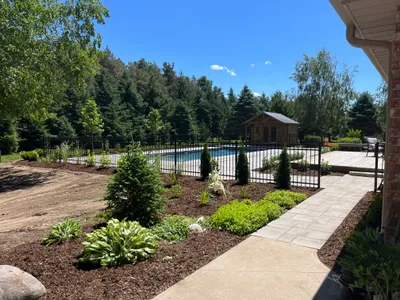
The fence must completely enclose the pool area. That means the house wall can serve as part of the barrier, but any doors or windows that open from the house into the pool area must have self-closing and self-latching mechanisms, or you need to run the fence around those openings.
One common mistake: homeowners assume their existing backyard fence meets the pool fence requirements. In many cases, it does not. A standard 4-foot privacy fence may meet the height requirement, but if it has horizontal rails on the pool side (which most privacy fences do), it is considered climbable and will not pass inspection.
What fence materials are allowed?
The Ontario Building Code does not specify exact fence materials, but the fence must meet the dimensional and functional requirements listed above. In practice, these are the most common fence types used for pool enclosures:
| Fence Material | Cost per Linear Foot (CAD) | Notes |
|---|---|---|
| Aluminium pool fence | $30 – $60 | Most popular for pool enclosures. Vertical pickets, no horizontal rails. Comes in black, bronze, and white. |
| Wrought iron style | $40 – $80 | Similar look to aluminium but heavier. Requires maintenance to prevent rust. |
| Vinyl privacy fence | $25 – $50 | Can work if it meets all requirements. Must not have climbable features on pool side. |
| Wood fence | $20 – $45 | Must have vertical boards only on pool side. Horizontal rails must face away from pool. Requires ongoing maintenance. |
| Glass panel fence | $80 – $200 | Tempered glass panels with no climbable features. Expensive but provides an unobstructed view. |
| Mesh pool fence (removable) | $15 – $30 | Meets code in some municipalities as a temporary barrier. Not accepted everywhere as a permanent solution. |
Aluminium pool fence is the most common choice for pool enclosures in our area. It meets all code requirements out of the box, requires almost no maintenance, and comes in colours that blend well with most backyards.
What does the application process look like?
A pool fence enclosure permit application typically requires the following documents:
- A completed application form. Available from your municipality's building department, usually downloadable from their website.
- A site plan. This shows your property boundaries, the location of the house, the proposed pool location, the fence line, gate locations, and setbacks from property lines. It needs to be drawn to scale or at least include accurate measurements.
- A fence detail drawing. This shows the fence height, picket spacing, gate hardware (self-closing hinges and self-latching mechanism), and latch height.
- A survey or lot grading plan. Some municipalities require an up-to-date property survey. If you do not have one, you may need to hire a surveyor, which adds $500 to $1,500 to the project.
- The permit fee. Paid at the time of application.
Many municipalities now accept applications online. The City of London offers online submission through their building services portal. Smaller municipalities may still require in-person submission.
How do requirements differ in Middlesex, Strathroy, and St. Thomas?
While the Ontario Building Code provides the baseline requirements, each municipality can add its own bylaws and processes. Here is a general comparison for the communities we serve:
| City of London | Middlesex Centre | Strathroy-Caradoc | St. Thomas | |
|---|---|---|---|---|
| Permit required? | Yes | Yes | Yes | Yes |
| Permit before excavation? | Yes | Varies | Varies | Varies |
| Online application? | Yes | Check with office | Check with office | Check with office |
| Fence inspection required? | Yes | Yes | Yes | Yes |
| Processing time | 2 – 6 weeks | 2 – 4 weeks | 2 – 4 weeks | 2 – 4 weeks |
The fence height, picket spacing, and gate requirements are consistent across these municipalities because they all follow the Ontario Building Code. The differences are mainly in the application process, fees, and the order of operations (whether the permit must be approved before or during installation).
If you live in a rural area or on a large property, your requirements may differ slightly. Some rural properties may have different setback rules. Always check with your local building department early in the planning process.
What happens if you skip the permit?
Skipping the pool permit is a bad idea for several reasons, and each one can cost you more than the permit itself.
Stop-work orders
If the municipality discovers that pool work is happening without a permit, they can issue a stop-work order. All construction stops until the permit is obtained. This delays your project and can result in additional fees and fines.
Fines
Most Ontario municipalities can impose fines for unpermitted construction. These fines vary but can be several hundred to several thousand dollars, on top of the permit fee you still have to pay.
Removal orders
In the worst case, the municipality can order you to remove the fence and rebuild it to code at your own expense. If the fence does not meet the safety requirements and someone is injured, the consequences are far more serious.
Insurance complications
Your home insurance company may deny a claim related to your pool if the pool was installed without proper permits. This includes liability claims if someone is injured on your property.
Problems when selling your home
When you sell your house, the buyer's lawyer will check for open or missing permits. An unpermitted pool can delay the sale, reduce the selling price, or require you to go through the permit and inspection process retroactively.
The permit costs a few hundred dollars and takes a few weeks. The consequences of skipping it can cost thousands and cause months of delays. It is simply not worth the risk.
Should your pool company handle the permit?
Many pool companies include permit handling as part of their service. They prepare the site plan, submit the application, pay the fee (or include it in the project cost), and coordinate the inspection.
Here is what to ask your pool company about permits:
- Is the permit fee included in the quote? Some companies include it; others list it as a separate line item.
- Who submits the application? The company should handle this, but confirm.
- Who provides the site plan? A good pool company will prepare the site plan based on your property survey or measurements. If a survey is needed and you do not have a recent one, ask who arranges and pays for it.
- Who coordinates the fence inspection? The company should schedule this at the right time in the project.
- What happens if the permit is delayed? Ask how permit delays affect your installation timeline. A company that has done many pool projects in your municipality will have a realistic sense of how long the process takes and will plan accordingly.
A pool company that works regularly in your municipality will know the local building department, the specific requirements, and the typical processing times. This experience is worth having on your side.
How can you avoid permit delays?
The most common cause of permit delays is an incomplete or incorrect application. Here are the things that help the process go smoothly:
- Apply early. If you want to be swimming by July, start the permit process in late winter or early spring. Do not wait until April when every other pool buyer in the city is also applying.
- Have your property survey ready. If you do not have a recent survey, get one done before you need it. This removes one of the most common holdups.
- Use a clear, accurate site plan. Show exact measurements for pool placement, fence lines, gates, and setbacks from property lines. A hand-drawn sketch with vague dimensions will likely be sent back for revision.
- Know your setbacks. The City of London requires pools to be set back a certain distance from property lines. Check these requirements before finalizing your pool placement so you do not have to revise the plan later.
- Choose your fence before you apply. The application needs fence details including height, picket spacing, and gate hardware. Having this information ready avoids back-and-forth with the building department.
- Respond quickly to any requests for additional information. If the building department asks for clarification, respond within a day or two. Every delay on your end adds to the total timeline.
Homeowners who plan ahead and submit a clean, complete application often get through the process in 2 to 3 weeks. Those who apply at the last minute with incomplete documents can wait 6 weeks or more.
Frequently Asked Questions
Do I need a permit to install a pool in London, Ontario?
Yes. The City of London requires a swimming pool fence enclosure permit before any pool installation can begin. This applies to all in-ground pools, including fiberglass, concrete, and vinyl liner pools. The permit must be approved and the fence must be inspected before the pool can be filled with water.
How much does a pool permit cost in Ontario?
Pool permit fees in Ontario typically range from $500 to $1,500 CAD depending on the municipality and how many permits your project requires. The City of London's pool fence enclosure permit fee is in this range and may change year to year. Check with your local building department for the current fee schedule.
How long does it take to get a pool permit in London, Ontario?
Pool permit processing in London typically takes 2 to 6 weeks from the time you submit a complete application. During peak season (spring and early summer), processing times tend to be longer because the building department receives more applications. Submitting early and ensuring your application is complete can help reduce delays.
What are the fence requirements for a pool in Ontario?
Ontario's pool fence requirements generally include a minimum fence height of 1.2 metres (4 feet), a self-closing and self-latching gate, no climbable features on the pool side, and gaps no larger than 100 mm (4 inches) between pickets. The fence must completely enclose the pool area and prevent unsupervised access, especially by young children.
What happens if I install a pool without a permit in Ontario?
Installing a pool without the required permit can result in stop-work orders, fines, and being required to remove the fence and start over. You may also face issues when selling your home, as a pool without proper permits can complicate the sale. Your insurance company may also deny coverage for an unpermitted pool.