Water chemistry sounds complicated, but it does not have to be. If you can follow a recipe, you can balance a pool. The basics come down to four numbers, a simple test kit, and about 10 minutes of your time a few days a week.
This guide is written for homeowners, not chemistry majors. We will keep it practical and skip the parts you do not need to know.
Why does water chemistry matter?
Balanced water keeps three things working properly: your health, your pool surface, and your equipment.
- Health. Water that is out of balance can irritate skin and eyes, and water without enough sanitizer can harbour bacteria and algae.
- Pool surface. Water that is too acidic eats away at surfaces over time. Water that is too alkaline deposits calcium scale on surfaces and equipment. Both problems are avoidable.
- Equipment. Corrosive water damages metal components like heaters, pump seals, and ladders. Scaling water clogs filters and heater elements. Balanced water protects the equipment you paid good money for.
The good news is that pool water does not need to be perfectly balanced every minute of every day. It just needs to stay within a reasonable range most of the time. Small fluctuations are normal and harmless. Big swings or long periods out of range are where problems start.
What are the four numbers you need to know?
There are dozens of things you can test in pool water. As a homeowner, you need to track four:
| Parameter | Target Range | What It Does |
|---|---|---|
| pH | 7.2 – 7.6 | Controls how acidic or basic the water is |
| Total alkalinity | 80 – 120 ppm | Buffers pH and prevents wild swings |
| Free chlorine | 1 – 3 ppm | Kills bacteria, viruses, and algae |
| Calcium hardness | 200 – 400 ppm | Protects surfaces from etching or scaling |
There is a fifth number, cyanuric acid, that matters if you use outdoor chlorine. We will cover that separately. But these four are your core. Get these right and your pool will stay clear, comfortable, and healthy.
What is pH and how do you adjust it?
pH measures how acidic or basic your water is on a scale from 0 to 14. Pure water sits at 7.0 (neutral). Pool water should be slightly above neutral, between 7.2 and 7.6.
Why that range? Two reasons:
- Chlorine effectiveness. At pH 7.2, about 65% of your chlorine is in its active form. At pH 8.0, only about 20% is active. So the same amount of chlorine is three times less effective at higher pH. Keeping pH in range means your sanitizer actually works.
- Comfort. Human eyes and skin have a natural pH of about 7.4. Water close to that range feels comfortable. Water below 7.0 stings. Water above 8.0 can feel slippery and irritate eyes.
How to lower pH
If your pH is above 7.6, add muriatic acid (hydrochloric acid) or dry acid (sodium bisulphate). Both work. Muriatic acid is cheaper but needs careful handling. Dry acid is easier to measure and pour.
Add the product to the deep end of the pool with the pump running. Wait at least 4 hours, then retest. Adjust again if needed. Do not try to make a big correction all at once.
How to raise pH
If your pH is below 7.2, add soda ash (sodium carbonate). Dissolve it in a bucket of pool water first, then pour it into the pool with the pump running.
One thing to know: pH naturally drifts upward over time. You will almost certainly add pH decreaser more often than pH increaser. This is normal.
What is total alkalinity and why does it come first?
Total alkalinity measures the water's ability to resist changes in pH. Think of it as a buffer or a shock absorber. When alkalinity is in range (80 to 120 ppm), pH stays relatively stable. When alkalinity is too low, pH bounces around wildly from one day to the next.
This is why you always adjust alkalinity before pH. If alkalinity is off, fixing pH is like trying to hit a moving target. You will adjust pH today and it will be out of range again tomorrow.
How to raise alkalinity
Add sodium bicarbonate (baking soda). Yes, it is essentially the same product you buy at the grocery store, but pool-grade quantities are cheaper per kilogram at a pool supply store. Add it to the pool with the pump running and retest after 6 hours.
How to lower alkalinity
Lowering alkalinity is trickier. Add muriatic acid in the deep end with the pump off, let it sink to the bottom for about 30 minutes, then turn the pump on. This targets alkalinity more directly than adding acid with full circulation. Retest the next day.
In practice, alkalinity is usually too low rather than too high, especially after heavy rain or after topping up the pool with soft municipal water.
How does chlorine work in a pool?
Chlorine is your pool's sanitizer. It kills bacteria, viruses, and algae. Without it (or an alternative sanitizer), your pool water would become unsafe to swim in within days.
You want to maintain free chlorine between 1 and 3 ppm (parts per million). Free chlorine is the active, available chlorine in the water. It is different from "total chlorine" and "combined chlorine."
Free chlorine vs. combined chlorine vs. total chlorine
| Type | What It Means |
|---|---|
| Free chlorine | Active chlorine ready to sanitize. This is the number you want between 1 and 3 ppm. |
| Combined chlorine | Chlorine that has already reacted with contaminants. It is "used up" and no longer effective. This is what causes the strong chlorine smell. |
| Total chlorine | Free chlorine + combined chlorine. If total is much higher than free, you have a chloramine buildup and need to shock. |
A common misconception: the "chlorine smell" that people associate with pools is not from too much chlorine. It is from chloramines (combined chlorine). A properly chlorinated pool has almost no smell. If your pool smells strongly of chlorine, you likely need to add more chlorine (shock), not less.
How to add chlorine
For daily maintenance, use chlorine tablets (trichloroisocyanuric acid) in a floating dispenser or an inline/offline chlorinator. Tablets dissolve slowly and provide a steady supply of chlorine.
For shocking (a heavy one-time dose), use calcium hypochlorite granules or liquid chlorine (sodium hypochlorite). Shock your pool every 1 to 2 weeks during swimming season, or whenever free chlorine drops below 1 ppm, after heavy rain, or after heavy use.
What is calcium hardness and why does it matter?
Calcium hardness measures how much dissolved calcium is in your water. The target range is 200 to 400 ppm.
Water naturally wants to hold a certain amount of calcium. If your water is too soft (low calcium), it will try to pull calcium from wherever it can, including your pool surfaces, grout, and equipment. Over time, this etches the surface. If your water is too hard (high calcium), the excess calcium deposits on surfaces as white scale.
How to raise calcium hardness
Add calcium chloride. Dissolve it in a bucket of water first (it generates heat when dissolving, so add the chemical to the water slowly), then pour it into the pool. Retest after 24 hours.
How to lower calcium hardness
This is the one parameter that is difficult to lower without draining and replacing some of the water. There is no chemical you can add to remove calcium. If your calcium is too high, the practical solution is to partially drain the pool and refill with fresh water that has lower calcium content.
In the London, Ontario area, municipal water calcium levels vary. Some areas have moderately hard water. A pool store can tell you the calcium level of your tap water so you know what you are working with.
What is cyanuric acid (stabilizer)?
Cyanuric acid (CYA), also called stabilizer or conditioner, protects chlorine from being destroyed by sunlight. Without it, UV rays can break down 90% of your free chlorine within two hours on a sunny day.
The target range for CYA is 30 to 50 ppm. Chlorine tablets (trichlor) contain cyanuric acid, so if you use tablets, your CYA level will slowly rise over time.
The problem with too much CYA (above 80 to 100 ppm) is that it reduces chlorine's effectiveness. The chlorine is still there, but it cannot work as well. This is called "chlorine lock" by some pool professionals, though the more accurate description is that the chlorine is just less potent.
Like calcium hardness, the only practical way to lower CYA is to drain and replace some of the water. This is one reason to check CYA at least once a month and consider switching to liquid chlorine or cal-hypo shock (which do not contain CYA) if your levels are climbing.
How do you test your pool water?
You have three options for testing, and using more than one is a good idea.
Test strips
Dip a strip in the water, wait 15 to 30 seconds, and compare the colour pads against the chart on the bottle. Test strips are fast and convenient, but they are the least precise option. They give you a ballpark, which is fine for quick daily checks.
Cost: about $15 to $25 CAD for a bottle of 50 strips.
Liquid test kits (drop test)
Fill a small vial with pool water and add reagent drops until the colour changes. Count the drops or compare the colour against a chart. Liquid test kits are more accurate than strips, especially for pH and chlorine. The Taylor K-2006 is a popular choice among pool owners who want reliable readings.
Cost: about $60 to $100 CAD for a quality kit.
Pool store testing
Bring a water sample to your local pool supply store. They will run a full computerized analysis that tests for everything, including parameters you cannot easily test at home. Most stores do this for free. It is a good idea to bring a sample every 4 to 6 weeks, even if you are testing at home regularly.
When collecting a water sample, dip the container about 30 centimetres below the surface, away from the return jets and skimmer. Water at the surface or near the jets may not represent the overall pool chemistry accurately.
What order should you adjust chemicals in?
This matters more than most people realize. Adjusting chemicals in the wrong order means you will likely have to redo the work. Here is the correct sequence:
- Total alkalinity first. This stabilizes the pH buffer. Get alkalinity into the 80 to 120 ppm range before touching anything else.
- pH second. Once alkalinity is set, adjust pH to 7.2 to 7.6. It will hold more reliably now.
- Calcium hardness third. Adjust to 200 to 400 ppm. This changes slowly and does not interact much with the others.
- Chlorine last. Once pH is right, chlorine works at full effectiveness. Adding chlorine when pH is 8.0 is wasteful because most of it is inactive at that pH level.
One chemical at a time. Add one product, let it circulate for at least 4 to 6 hours (overnight is better), then retest before adding the next. Adding multiple chemicals at once can cause reactions you did not expect.
How often should you test and adjust?
| Parameter | How Often to Test | How Often You'll Adjust |
|---|---|---|
| Free chlorine | 2 – 3 times per week | Weekly or as needed |
| pH | 2 – 3 times per week | Weekly (it drifts upward naturally) |
| Total alkalinity | Once per week | Monthly or after heavy rain |
| Calcium hardness | Once per week | Rarely (changes very slowly) |
| Cyanuric acid | Once per month | Rarely (only rises if using trichlor tablets) |
Also test after any unusual event: heavy rain, a large pool party, adding fresh water, or after the pool has been unused for a while.
The whole testing routine takes about 5 to 10 minutes. Once you have done it a few times, it becomes second nature.
Are there special considerations for fiberglass pools?
Fiberglass pools follow the same water chemistry targets as any other pool type, but there are a few things specific to the gel coat surface worth knowing.
- Calcium hardness is important. Keep it between 200 and 400 ppm. Water that is too soft (below 200 ppm) can draw minerals from the gel coat over time, leading to dullness or cobalt spotting in some cases. This is not common, but it is preventable by keeping calcium in range.
- You will use less chlorine. The smooth gel coat surface of a fiberglass pool resists algae much better than the rough surface of a concrete pool. Algae has fewer places to grip and grow. This means you generally go through less chlorine and algaecide than a concrete pool owner would.
- Avoid copper-based algaecides. Copper can stain the gel coat, leaving blue-green marks that are difficult to remove. If you use an algaecide, choose a copper-free (polymer or quat-based) product.
- Be careful with granular chemicals. Do not pour undissolved granular chemicals directly onto the pool floor. Concentrated chemical sitting on the gel coat can cause bleaching or discolouration. Always pre-dissolve granular products in a bucket of water and pour the solution into the pool while walking around the perimeter.
- Avoid very high chlorine levels for extended periods. Shock treatments are fine, but leaving chlorine above 10 ppm for days at a time can dull the gel coat over years. After shocking, let the level come back down to 1 to 3 ppm before covering the pool or reducing circulation.
What are the most common water chemistry mistakes?
After helping homeowners with their pools for over 40 years, here are the mistakes we see most often:
- Adjusting pH before alkalinity. This is the number one mistake. pH keeps bouncing around because the alkalinity buffer is off. Fix alkalinity first and pH becomes much easier to manage.
- Adding too much chemical at once. Overcorrecting is worse than undercorrecting. If you overshoot, you have to add the opposite product to bring it back, and then you might overshoot again. Make small adjustments, wait, retest.
- Not testing often enough. "I added chemicals last week" is not the same as knowing where your levels are today. Water chemistry changes daily based on weather, usage, and rainfall. Test regularly.
- Dumping chemicals directly into the skimmer. Some products, especially chlorine tablets, should not go into the skimmer. Concentrated chemical flowing directly through the pump and plumbing can damage seals, gaskets, and heater elements.
- Ignoring cyanuric acid buildup. If you use trichlor tablets all season, CYA slowly climbs. By late summer, it can be over 100 ppm, making your chlorine much less effective. Monitor it monthly and switch to liquid chlorine or cal-hypo if CYA gets above 50 ppm.
- Testing in the wrong spot. Test water from 30 centimetres below the surface, away from return jets. Surface water and water near jets are not representative of the whole pool.
Quick troubleshooting guide
Here are the most common water problems and what usually fixes them:
| Problem | Likely Cause | Fix |
|---|---|---|
| Green water | Algae growth (low chlorine, high pH, or both) | Check and lower pH, then shock heavily. Brush walls. Run filter 24/7 until clear. |
| Cloudy water | Poor filtration, high pH, or low chlorine | Clean filter, check chemistry, shock if needed. A clarifier can help speed things up. |
| Strong chlorine smell | Chloramines (combined chlorine) | Shock the pool to break up chloramines. You need more chlorine, not less. |
| Eye and skin irritation | pH out of range or high chloramines | Adjust pH to 7.2 – 7.6. Shock to remove chloramines. |
| White scale on surfaces | High calcium hardness or high pH | Lower pH. If calcium is above 400 ppm, partially drain and refill. |
| Staining (blue-green) | Copper from algaecides or source water | Stop copper products. Use a metal sequestrant. Test source water for metals. |
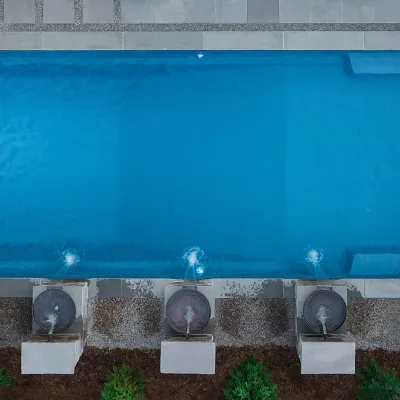
| pH keeps drifting up | Low alkalinity or aeration (water features, spillovers) | Raise alkalinity to 80 – 120 ppm. Reduce water feature run time if possible. |
For most of these problems, the fix starts with testing the water and identifying which number is out of range. The chemistry tells you what to do.
Frequently Asked Questions
How often should I test my pool water?
Test your pool water at least 2 to 3 times per week during swimming season. Test chlorine and pH most frequently since they change the fastest. Alkalinity and calcium hardness can be checked once a week. After heavy rain, a pool party, or adding chemicals, test again. Bring a sample to a pool store every 4 to 6 weeks for a full professional analysis.
What should my pool pH be?
Your pool pH should be between 7.2 and 7.6. The ideal target is 7.4 to 7.6. Below 7.2, the water becomes acidic and can irritate skin and eyes. Above 7.6, chlorine becomes less effective and calcium can start to scale on surfaces. pH naturally drifts upward over time, so you will likely add pH decreaser more often than pH increaser.
What is the difference between free chlorine and total chlorine?
Free chlorine is the active chlorine available to sanitize your water. Total chlorine is free chlorine plus combined chlorine (chloramines). Combined chlorine is chlorine that has already reacted with contaminants and is no longer effective. If total chlorine is much higher than free chlorine, you have chloramines building up and need to shock the pool.
Do fiberglass pools need different water chemistry than concrete pools?
The target ranges are the same, but fiberglass pools are more sensitive to calcium hardness. Keep calcium between 200 and 400 ppm. Water that is too soft can slowly damage the gel coat surface. Fiberglass pools also require less chemical overall because the smooth gel coat resists algae better than rough concrete surfaces, so you generally use less chlorine and algaecide.
Why does my pool turn green even though I add chlorine?
Green water usually means algae has outpaced your chlorine. This happens when pH is too high (making chlorine ineffective), when chlorine levels drop too low for too long, or when cyanuric acid (stabilizer) levels are too high. Check pH first. If it is above 7.8, chlorine loses most of its killing power. Shock the pool, brush the walls, and run the filter until the water clears.